





No More Blind Food. No More Invisible People. A Manifesto
The System Is Hiding Something
Pick up any food product in any grocery store in any city in America.
Look at the label.
Now ask yourself: what do you actually know about what is inside it?
Not the marketing. Not the claim printed in bold on the front panel.
What do you know about where that ingredient was grown? How many hands, suppliers, and opaque documents it passed through before it became something you are about to eat?
Most people know almost nothing.
Here is the harder truth: most food companies do not know much more.
That is not a scandal. It is a symptom. The food system was not built for visibility. It was built for scale, speed, and margin. And the same logic that built the food system built everything else — the labor market, the media economy, the cultural infrastructure, the global supply of human attention.
Opacity is not a food problem. It is the operating system.
The People Are Hiding Too
Look at the full value chain of anything. Not the shelf. Not the brand. The whole chain.
The people closest to any system — the ones who handle it, build it, inspect it, stock it, cook it, clean it up after — have been the most systematically excluded from the intelligence economy. They have titles, not leverage. They have proximity, not access.
This is not new. Langston Hughes wrote about it in 1935 in the pages of New Masses and the Chicago Defender, watching what Soviet Central Asia was doing for its working poor and asking why America could not look its own people in the face. The question he was really asking was not about education policy. It was about who a society decides is worth building infrastructure for.
We are still asking that question. The answer has not changed much.
A new economy is forming around pattern recognition, AI tools, data trust, and systems thinking. The ability to see what others miss is worth more than the ability to execute a fixed process. And the people with the sharpest instincts — the ones who have been surviving on pattern recognition their entire lives because they had no other option — are being left out of the economy they helped build.
No more invisible people.
The Two Crises Are the Same Crisis
We are living through what looks like two separate emergencies.
The first is economic. Job titles are collapsing. AI is reshaping entire categories of work faster than institutions can respond. Inflation gutted the middle-class pathway. The systems that promised stability — employers, credentials, unions, safety nets — are not holding. People are not just losing jobs. They are losing identity.
The second is cultural. We have built a global content economy that rewards speed over depth, performance over knowledge, and visibility over truth. The people who understand things most deeply — who have spent years in proximity to real problems — are the least legible to the platforms, investors, and institutions that decide what gets amplified.
These are not separate crises. They are the same crisis running in two registers.
The intelligence economy needs the people it is currently discarding. Neurodivergent thinkers, working-class operators, caregivers, artists, people who have been told their way of seeing is a liability — those are the pattern finders. Those are the systems thinkers. That is the workforce the next economy actually needs, and it keeps looking for them in the wrong places, through the wrong pipelines, with the wrong requirements.
2027 Is Not a Warning. It Is Already Here.
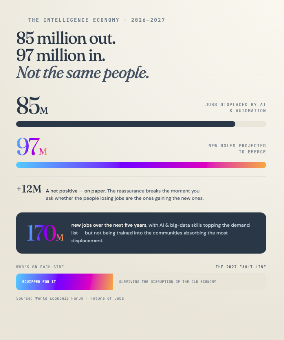
By the end of 2026, an estimated 85 million jobs will have been displaced globally by AI and automation — and 97 million new roles are projected to emerge in their place. That net positive number sounds reassuring until you ask the harder question: are the people losing jobs the same people gaining access to the new ones?
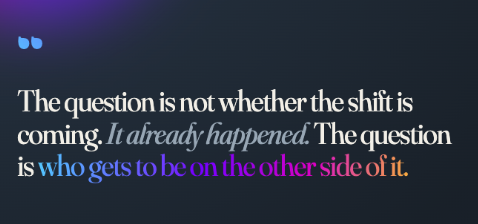
They are not. Not yet. The World Economic Forum projects 170 million new jobs created over the next five years, with AI and big data skills at the top of the demand list. But those skills are not being trained into the communities absorbing the most displacement. By 2027, the gap between who is equipped for the intelligence economy and who is simply surviving the disruption of the old one will be one of the defining fault lines of American life. The question is not whether the shift is coming. It already happened. The question is who gets to be on the other side of it.
What Invisibility Actually Costs
Let us be specific, because this is not abstract.
It costs speed. When knowledge lives in people's heads and never gets formalized, every organization rebuilds from scratch every time someone leaves. Every sector. Every institution. Every field.
It costs trust. Claims without traceable infrastructure are not transparency. Whether you are talking about a food label, a news story, an AI output, or a political platform — if you cannot show your work, you are asking people to trust marketing.
It costs leverage. When the people doing the most essential work are invisible to the systems benefiting from that work, they have no power to prove their value or defend their position. That is not a coincidence. It is a design choice.
And it costs the future. When the intelligence layer of any system is locked inside elite networks and expensive credentials, the people who understand that system most viscerally get left out of the economy forming around it. That is true in food. It is true in art. It is true in every sector being remade by AI right now.
Invisibility is not a nuisance. It is a structural injustice running through every system we have built.
AI Is Not the Problem. What We Do With It Is.
I am a builder in the AI space. I believe in the technology. I have watched it do things that were not possible five years ago — and I am building infrastructure on top of it because I genuinely believe food intelligence can be a pathway into the new economy for people who have never had one.
And I will say clearly: the way we are currently deploying AI is going to deepen every inequality I just described, unless we make different choices on purpose.
AI trained on the outputs of undervalued labor, without crediting or compensating the people whose knowledge trained it, is extracting the same people it claims to serve. AI deployed to automate the jobs of working people without creating real pathways into the new economy is displacement with better branding. AI used to produce content at scale without genuine human signal is just faster noise.
The question is not whether AI is good or bad. The question is who it is being built for, who it is being built by, and what assumptions about human value are baked into the systems we are shipping.
I care about this because I am a founder and because I am an artist and because I have sat in rooms where the people making decisions about these systems have never been in the rooms I have been in. That is not bitterness. That is a data problem.
Art Is Not Decoration
I make films. I am a sculptor. I came up in spaces where creative practice was treated as adjacent to the real work — a nice-to-have, a soft skill, proof you had a personality outside your job.
That framing is wrong and it is expensive.
Art is how a culture processes what it cannot say out loud yet. It is how new ideas get tested before they are legible to institutions. It is how people who have been excluded from official narratives write themselves back into the record. The Black press understood this in 1935. The muralists understood it. The jazz musicians understood it. Every generation of people who have been told their experience does not count has had to build its own distribution network, its own publishing house, its own film circuit, to get the story told at all.
That is not history. That is now. The tools have changed. The underlying dynamic has not.
I am making Strange Little Fruit because some stories do not fit inside the formats that exist yet. That is not a creative indulgence. That is how new formats get built.
Creativity Is the Throughline
Here is what the AI discourse keeps getting wrong: it treats creativity as the thing being replaced, when creativity is the thing that cannot be replicated.
AI can generate. It cannot mean. It can pattern-match every film ever made, but it cannot carry the specific grief of a grandmother's kitchen or the particular fury of watching your community get written out of an economic future that needed them. It can produce at scale, but it cannot produce from inside an experience. That is not a limitation that better models will eventually solve. That is a structural truth about what human creative intelligence is and where it comes from.
The economy that is forming — the one that runs on pattern recognition, systems thinking, and trust — is not going to be won by whoever has the fastest model. It is going to be won by whoever can bring genuine human signal to the intelligence layer. The people who have survived by reading rooms, translating between worlds, making meaning out of scarcity, and building culture out of exclusion — those people have been doing creative intelligence work their entire lives. They just were not paid for it or called by its real name.
This is why art and identity are not soft topics on the edge of the economic conversation. They are the center of it. The most valuable thing a person will carry into the next decade is not a certification. It is a perspective that cannot be downloaded. A way of seeing that took a lifetime to build. A voice with something specific inside it.
Creativity is not what gets automated away. Creativity is what remains when everything automatable has been automated. And the people who have been most creatively forced — by circumstance, by exclusion, by the necessity of making something from nothing — are the ones who are about to discover that their greatest liability was actually their most durable asset.
The New Identities Are Already Here
The old economy gave people job titles. Manager. Coordinator. Technician. Associate. Operator. Those titles were containers for value that belonged to someone else. They were not yours to carry into a new economy when the market shifted.
The new economy needs people with signal, pattern, and systems intelligence — and it needs people who can make those signals mean something to other human beings. Data without story is noise. Analysis without context is guesswork. The intelligence economy does not just need people who can see patterns. It needs people who can communicate what the patterns mean, who can build trust around them, who can translate between the technical and the human.
That is a creative act. And it means new identities are available right now, to anyone willing to claim them.
- A grocery worker can become a Food Data Scout
- A caregiver can become a Nutrition Pattern Researcher
- A warehouse associate can become a Supply Chain Intelligence Mapper
- A neurodivergent thinker can become an Ingredient Intelligence Analyst
- A laid-off operator can become an AI-Enabled Product Auditor
- A community organizer can become a Civic Data Analyst
- An artist can become an Experience Architect
- A teacher can become a Learning Systems Designer
- A storyteller can become a Trust Translator — the person who makes complex systems legible to the humans who have to live inside them
None of that is hypothetical. Those are real functions the economy needs and does not have enough people filling. The intelligence economy needs people who know how to read rooms, hold complexity, and see what is about to happen before it does.
Your next identity is not your old job title. It is the intelligence you already carry — sharpened by everything you have survived, everything you have made, and everything you have been forced to understand — connected to tools that finally let you act on it at scale.
The Infrastructure Is Being Built
This is not a wish. It is a construction project.
I am building part of it. Others are building it in other sectors. The people who will power the next economy are not sitting in MBA programs. They are already working. They are already seeing. They just have not been given the infrastructure to scale what they know.
That infrastructure has to be built on purpose — with the people who have been excluded from the last version — or we will automate our way into a more efficient version of the same inequality.
AI should give people leverage, not erase them.
Who This Is For
This is for the scientist who knows the better solution exists but cannot get the data fast enough.
It is for the founder trying to build something real without the backing that gets handed to other people by default.
It is for the procurement manager, the policy analyst, the soil scientist, the community health worker, the teacher, the artist, the operator who sees risk before leadership does and cannot get anyone to listen.
It is for the neurodivergent thinker who has been told their way of seeing is a liability in every room they have walked into.
It is for the caregiver who has been managing complexity under resource pressure and building expertise that no institution will formally recognize unless someone changes the credential.
It is for the filmmaker who knows the story exists but does not have a format for it yet.
It is for the consumer, the citizen, the worker who is tired of trusting claims nobody can prove.
This is not for the already powerful. The already powerful have the infrastructure — the data teams, the access, the networks.
This is for everyone the system forgot to build for.
You do not need elite access to become essential in the intelligence economy. You need a pathway. You need tools. You need someone to name what you already know how to do.
The Thesis Is Simple
The systems we built are too opaque. The people who understand them most are the most invisible. And the economy is shifting in a way that either leaves them further behind — or, if someone builds the right infrastructure, finally brings them in.
The old economy gave people job titles.
The new economy needs people who can see.
No more blind food.
No more invisible people.
The future belongs to people who can see what others miss.