





Taylor Farms, Cyclospora, and the Automation Math That Finally Came Due
"Three wage workers for every salad cleaning robot." I heard it in a factory ten years ago. This month the bill arrived, and it came to 1,645 confirmed cases.
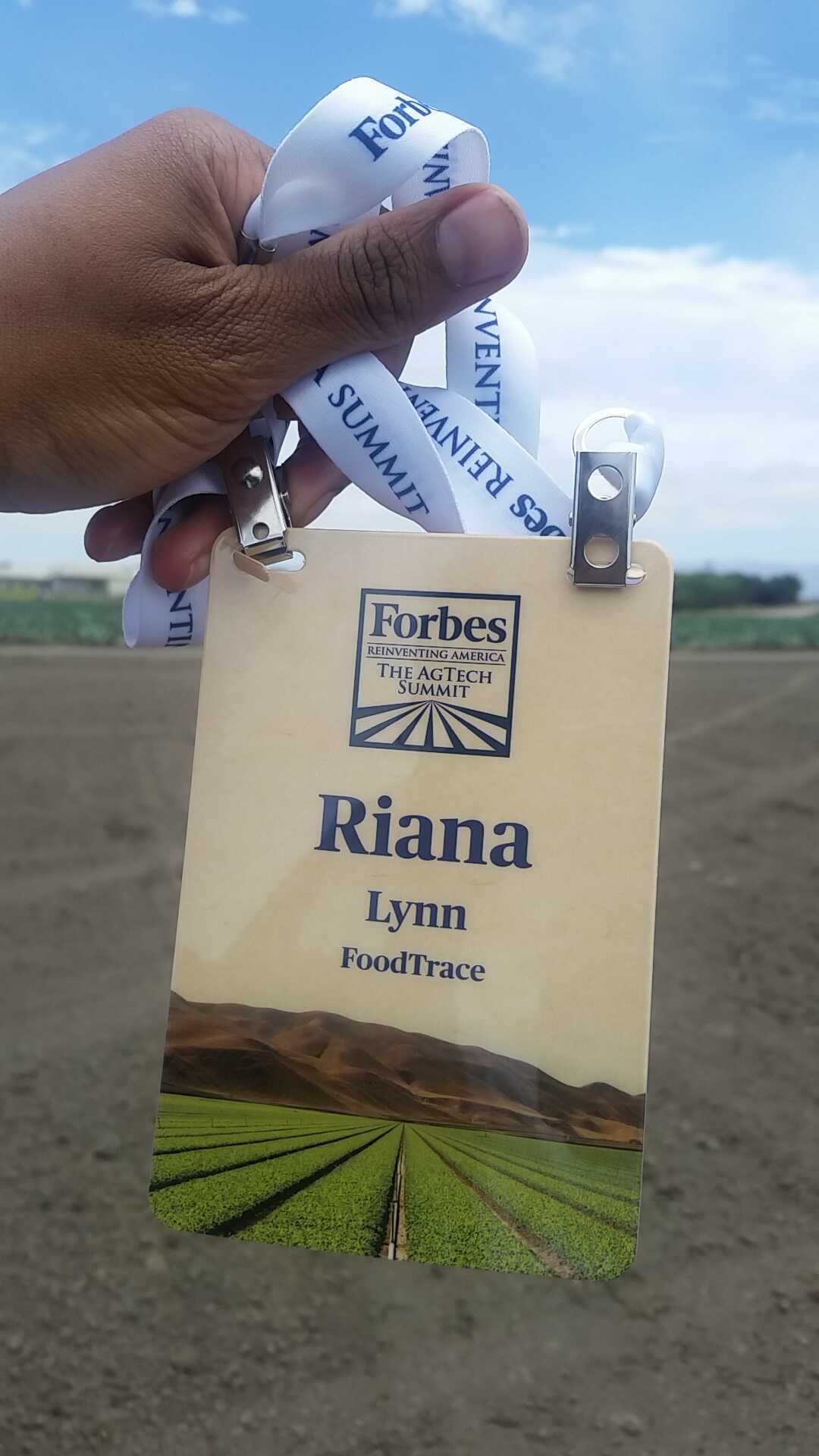
I still have the badge. Forbes Reinventing America: The AgTech Summit. My name as a young visionary in food before my time finished at Google and before starting in VC. Even before Journey Foods. I was there wide-eyed: enamored with the "precision" "robots" "cost-savings" but spiritually perplexed.
I was there by invitation. Forbes brought in people they considered top leaders in innovation and asked us, without irony, to think about reinventing America. I was the youngest person in most of those conversations and almost certainly the most creative, which in that setting is a compliment and a warning at the same time.
And I loved it. I want that on the record before anything else. I loved the site visits, the equipment, the scale, the sheer engineering ambition of moving that much fresh product across a continent before it turns. Anyone who says industrial agriculture isn't impressive has never stood inside it.
Then, on a Taylor Farms floor, someone said a sentence I have never been able to put down.
"We are replacing three wage workers for every new salad cleaning robot."
It wasn't offered as a warning. It was offered as an achievement. That's the part I keep returning to. Nobody in that room flinched. The number was a metric, the metric was moving the right direction, and everyone nodded.
I've quoted it in keynotes, in investor meetings, in arguments with people building the same things I build. I quote it because it's the cleanest expression I've ever heard of a bargain our food system made without asking anyone whether they agreed to it.
Inside and outside at the same time
I want to be precise about why that sentence landed differently for me, because it wasn't virtue.
I come from food people. Landowners and operators, the generation that worked ground and ran the business of working ground. That heritage isn't decorative. It means I grew up around people for whom a harvest was a household, not a yield figure, and for whom the gap between a good season and a bad one showed up at a kitchen table. When someone says three workers, I don't hear a line item. I hear three households.
But I didn't enter this industry through the land. I came in through a genetics lab. Nutrigenomics, the study of how food and bodies write each other. I was trained to think of food as something that ends up inside a person, and to distrust any model that stops at the factory door.
That combination is the whole thing. Lineage from the growing side, training from the science side, and by then a company of my own. I've since built a multimillion-dollar food business, which means I've signed the invoices, hit the margins, and made the exact tradeoffs I'm about to criticize. I'm not writing from the balcony. I'm writing from the floor.
Insider enough to be invited, to read the P&L, to know precisely why the robot pencils out. Outsider enough to still hear what the room had stopped hearing.
That's the real argument for who gets to build, and it isn't fairness. It's accuracy. A room that thinks alike will optimize brilliantly and be wrong in the same direction all at once, and won't find out for a decade. I was young, I was a woman, I'd come up through science instead of capital, and none of that made me smarter than anyone standing there. It just meant I was positioned to notice the sentence. Everyone inside the consensus only hears the weather.
What three to one actually buys
Three to one isn't an efficiency statistic. It's a transfer.
Three people's wages become one machine's depreciation schedule. Three people's shifts become one maintenance contract. And critically, three people's eyes become one sensor array pointed at whatever the engineers thought to point it at.
That last part is what the industry never books. A person on a wash line who's done the job for six years knows what wrong looks like before wrong has a name. They notice the smell that's slightly off, the water cloudier than yesterday, the pallet that sat too long on a hot dock. None of that lives in a spec sheet. It's knowledge held in bodies, and when you remove three bodies you remove three instruments that were never on the balance sheet to begin with.
We called that removal progress. We built the ROI models to prove it. I have built some of those models.
Then this month happened
On July 14, the CDC issued a Health Alert Network advisory reporting 1,645 confirmed cases of cyclosporiasis and more than 5,100 probable ones. Illnesses began as early as May 13. Ninety-four people were hospitalized. Michigan alone logged more than 5,000 cases, making this the largest Cyclospora outbreak on record in the United States.
On July 17, Taylor Farms de Mexico voluntarily recalled all iceberg lettuce sourced from central Mexico. The product had shipped to 27 states between June 29 and July 16 through Walmart's Marketside line and foodservice channels including Taco Bell. The FDA later acknowledged that one test result had been a false positive, and the company noted that no positive product test for Cyclospora has been identified. The traceback case rests on epidemiology and patient interviews rather than a laboratory finding in the food, which is ordinary for this parasite and part of the problem.
I want to be careful here, because the easy version of this essay is the one where a company is the villain. That isn't the essay. Taylor Farms feeds millions of people at a scale most consumers never think about, and they pulled product in abundance of caution on evidence that was still forming. A recall is the system working.
But a recall is also a confession that detection happened downstream of harm. By July 17, illnesses had been accumulating for nine weeks. The lettuce was already on plates in twenty-seven states. At that point the question is no longer prevention. It's damage.
The pathogen is a labor story
Cyclospora moves through contaminated water and soil. It does not care about your automation roadmap. It's a pathogen of conditions: water quality, sanitation infrastructure, worker facilities in the field, plumbing at the packing house, whether somebody had a clean place to wash their hands two hundred miles from where you're reading this.
Here is the number that should end the argument. One in three US farmworkers lacks consistent access to clean drinking water while working in the field. Seventy-two percent of California farmworkers report living in overcrowded housing. These aren't welfare statistics. They are the exact environmental conditions in which a waterborne parasite propagates, sitting directly upstream of the lettuce.
We automated the cleaning. We never automated the conditions that made cleaning necessary.
The part nobody says out loud
The three-to-one ratio and the outbreak are the same story told twice.
When you optimize a supply chain for labor cost, you're also optimizing for everything labor cost travels with. Labor is cheapest exactly where water infrastructure is thinnest, where sanitation investment is lowest, where a worker has the least standing to say this doesn't look right and be heard. Forty-one percent of US crop farmworkers lack legal work authorization, which is another way of saying that a significant share of the people closest to the contamination have the least ability to report it.
The efficiency and the vulnerability aren't separate variables. They're the same variable, read from two directions.
This is what I mean by equity in food, and I mean it structurally, not sentimentally. It isn't a moral supplement bolted onto a technical problem. The dignity of the people inside the chain, their wages, their water, their standing to raise a hand, is a food safety input. It sits upstream of every downstream metric we actually measure. Skip it and the system doesn't get more efficient. It gets more brittle, in ways that surface in a hospital nine weeks later on somebody else's ledger.
Eight billion people eat. A vanishingly small number of them have any say in how the food arrives. That gap is the whole problem, and every technology we deploy either narrows it or widens it. There is no neutral build.
What I'd tell the woman holding that badge
She was certain traceability would fix this. Give the system perfect information, she thought, and the system will make better choices.
She was half right, and the wrong half nearly cost her the point. Information has no conscience. A perfectly instrumented supply chain optimizes for precisely what you told it to optimize for, at machine speed, forever. Tell it to minimize cost per unit and it will find the cheapest water on earth and route your lettuce through it, flawlessly, and the dashboard stays green the entire time.
The question was never whether we could see the system. It was what we'd decided the system was for.
So: automate the dangerous work. Automate the repetitive work that wrecks shoulders and wrists by forty. I'm not nostalgic about conditions on a wash line. I've stood on those floors, and there's nothing romantic there. But automate toward something. Toward fewer people getting sick. Toward workers who move up instead of out. Toward resilience that holds when a growing region has a bad water year.
If all the robot delivers is three fewer paychecks and one more single point of failure, that isn't the future. That's cost-cutting wearing the future's clothes.
Ten years from now
Someone will stand in a facility I can't picture yet, and a person in a company polo will say a number out loud, and the room will nod because the number is moving the right direction.
I hope somebody in that room asks what the number is for. I hope the answer is more than a margin. I hope she doesn't wait ten years to say something.
I did. That's the honest ending. I heard that sentence a decade ago, knew immediately something was wrong with it, then spent ten years building inside the system that produced it, profitably and at times enthusiastically. Still building. That's not a confession, it's the position I write from. You don't get to critique a system you've never had to make payroll inside.
But I'm finished pretending the technical question and the human question are two different questions. My family knew that before I did. They just called it farming.
They were always one question. We kept answering the easier half.