


The Creative Scientist
There is a particular loneliness to being both a scientist and an artist, and I have decided to call it a gift.
The scientist in me wants to measure the world. To hold it still long enough to name what it is made of, to run it through a model, to watch the numbers settle into something I can trust. The artist in me knows better. The artist knows that the moment you believe the world is finished, you have stopped looking at it. James Baldwin wrote that a society must assume it is stable, but the artist must know, and must let us know, that there is nothing stable under heaven. I have carried that sentence with me through farms and code, through fundraising rooms and 2 a.m. edits. It is the truest thing I know about my work.
Because here is the strange arithmetic of my life: I received a patent for a system that uses neural networks to generate recipes. Machines that dream up how to feed people. And I did not build it as a technologist backed by a giant. I built it as a founder and a scientist who kept asking the same question until it became a company -- who is actually designing the food we eat? The answer was almost nobody. There are over forty thousand packaged products for every food scientist working today. We have handed the nourishment of eight billion people to a system too concentrated to be creative, too slow to be honest, and too tired to be beautiful.
That is a scientific problem. It is also a problem of imagination. And I have come to believe you cannot solve the first without the second.
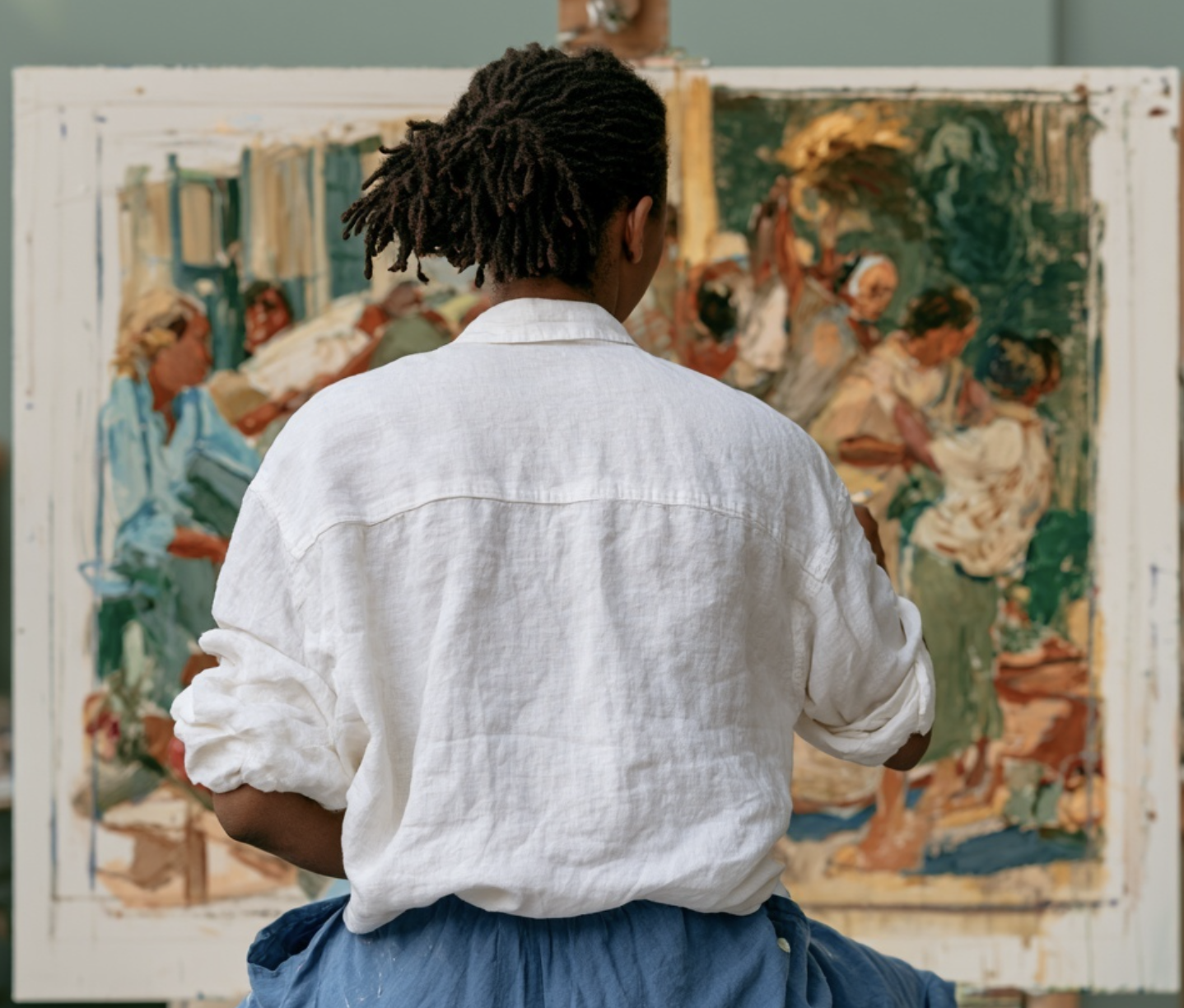
The lab is a lab of acrylics
People assume the science is the serious part and the art is the indulgence. I have found the opposite. The rigor is easy to respect. The harder discipline is the one Baldwin points at — the artist cannot take anything for granted, but must drive to the heart of every answer and expose the question the answer hides. That is what a creative scientist does with data. You do not accept the dataset. You interrogate what it refuses to show you. Whose nutrition never got measured. Whose foodways were never entered into the record. Whose hunger was labeled a desert, as if it were weather and not a decision someone made.
My lab is a lab of acrylics. The data is a canvas. When I look at a supply chain, I am not only seeing a spreadsheet of spoilage and margin -- though I am seeing that, and it is real, and sixty percent of the world's food waste is a number I can act on. I am also seeing a composition. Where the color is missing. Where the picture is out of balance. Where a whole community of eaters was painted out of the frame, and my job is to paint them back in.
The neural network does not do this on its own. It scales what I ask it. So I had better ask it something worth scaling. That is the creative act inside the technical one, and no model will do it for you.
You must continue to study yourself
Baldwin says the one face you can never see is your own. Your lover sees it, your brother sees it, your enemy sees it ... but you are working blind. He is talking about people, but I think it is the truest thing about builders too. The company you build wears a face you cannot fully see. The product does things to people you did not intend. The data has your assumptions baked into it, and assumptions are the hardest thing in the world to notice, because they feel like the floor.
So the work never stops being self-work. I study the food system, and the food system studies me back -- shows me my own shortcuts, my own hunger to be finished, my own temptation to call a thing solved so I can rest. If we understood ourselves better, we would damage ourselves less. I believe that about founders. I believe it about scientists. I believe it about anyone holding a tool powerful enough to reshape how others live.
To be a creative scientist is to accept that you are never done being a subject of the experiment. You do not get to stand outside the canvas. You are in it, mixing the color with your own hands, and the picture will always tell the truth about you whether you meant it to or not.
Painting the world a little more whole
I do not think my job is to make the world stable. I think my job is to make it a little more whole and a little more beautiful, and then to admit that whole and beautiful are moving targets that I will chase for the rest of my life. The measure of our maturity --as people, as companies, as a species trying to feed itself. Well, it is how well we are prepared to meet change and use it for our health.
That is the future I am building toward, every single day. Not a food system that is efficient and dead. One that is alive. One where the people closest to the problem are the ones designing the solution. One where equity is not charity extended downward but imagination extended outward: the simple, radical belief that everyone deserves to be in the picture, well-fed and well-drawn.
The science gives me the tools. The art tells me what to build. And the studying-of-myself, endless and humbling, keeps me honest about the difference.
I mix another color. The canvas is enormous. I have only started.