


The Wild Robot Review: A Machine Learns Care
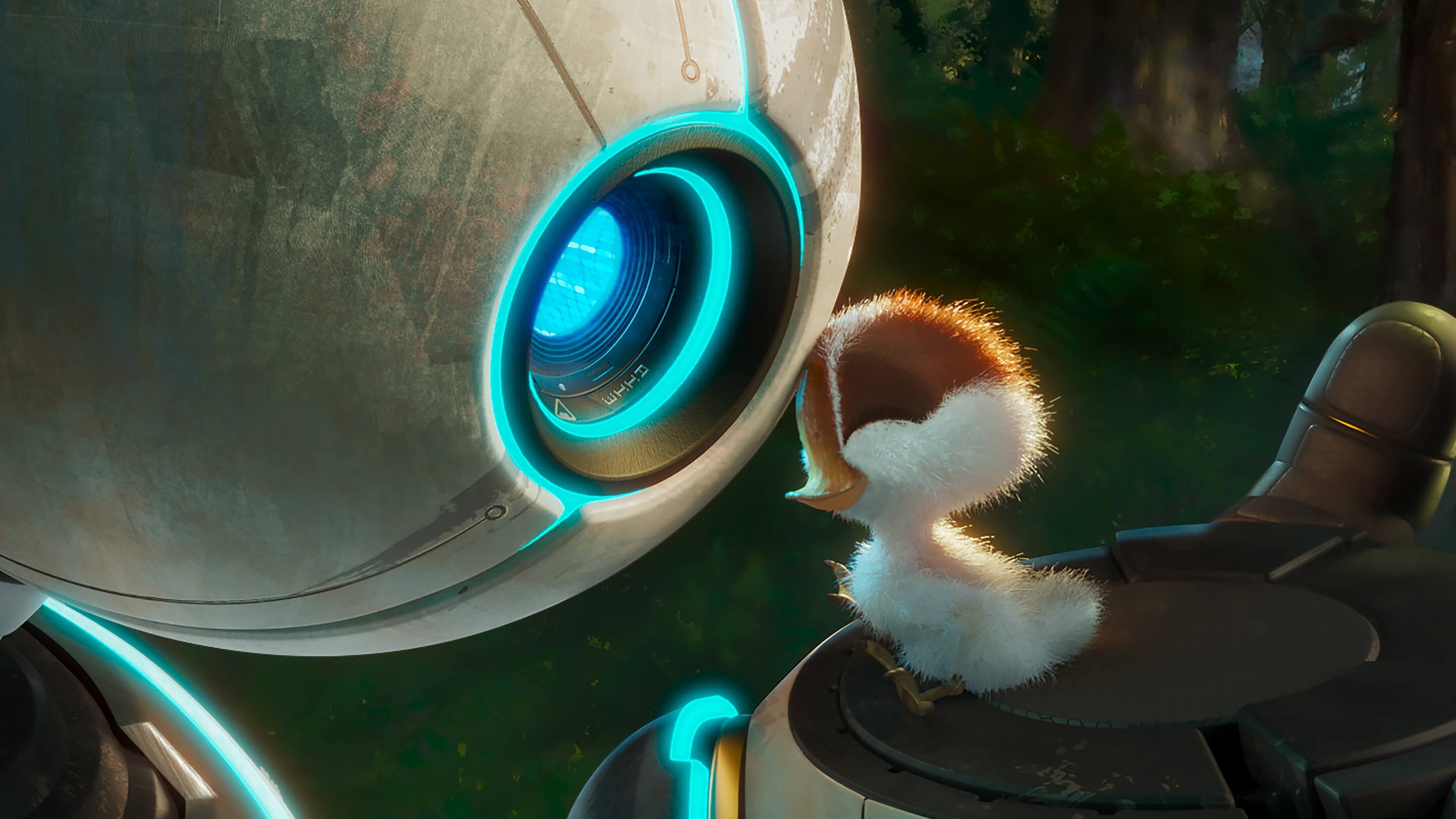
The most important AI story of 2024 was not a product launch. It was a cartoon about a robot raising a goose.
I say that as someone who holds a patent on a neural network system that generates recipes and who has spent years building AI for the food industry. I watch a lot of films about machines. Most of them are about fear. The Wild Robot is about something harder to put on screen: what happens when a machine built to complete tasks meets a world that only needs care.
The details: The Wild Robot (2024). Written and directed by Chris Sanders for DreamWorks Animation, based on Peter Brown's 2016 novel. Voices by Lupita Nyong'o, Pedro Pascal, Kit Connor, Bill Nighy, Stephanie Hsu, Matt Berry, Ving Rhames, Mark Hamill and Catherine O'Hara. Score by Kris Bowers. Premiered at the Toronto International Film Festival and released by Universal on September 27, 2024. Streaming on Peacock at the time of writing, and available to rent or buy.
A service robot with no one to serve
A storm knocks six robots off a cargo ship, and they wash up on an uninhabited island. Only one survives: ROZZUM unit 7134, who becomes Roz, voiced by Lupita Nyong'o. She is a helper robot. She wants a task. The animals think she is a monster.
Then she accidentally crushes a goose nest. One egg survives. The gosling hatches, imprints on her, and suddenly Roz has a task after all. A mother opossum, voiced with comic exhaustion by Catherine O'Hara, explains the assignment: make sure he can eat, swim and fly before the winter migration.
That is the whole engine of the film, and it is brilliant. Parenting is the one job that can't be completed. There is no checkbox at the end. Roz keeps trying to finish, and the film keeps gently showing her that finishing was never the point.
Programming is not destiny
The idea I keep coming back to is this. Roz is built to optimize. She learns to speak with every animal on the island. She learns to build a shelter, to teach flight, to protect a fox she does not fully trust. By the end, she is doing things no product manager at her fictional manufacturer, Universal Dynamics, would ever have written into a spec.
In the AI world, we talk constantly about alignment, about getting machines to want what we want. The Wild Robot flips the question. What if the more important variable is the environment we put the machine in? Roz becomes kind because the island asks her to. The company that made her, when it finally shows up to retrieve her, sees only a product to recover.
I think about that a lot when I look at how AI gets deployed. A model trained to maximize engagement will do exactly that. A tool designed inside a community, with real needs and real feedback, can become something better. The context is part of the code.
It looks like a painting
As someone making an animated film, I have to talk about the craft. Sanders and his team gave The Wild Robot a watercolor look inspired by classic Disney films and the work of Hayao Miyazaki. The forests have brushstrokes. Light pools and bleeds. In a medium that often chases polish, this film chooses texture, and the texture makes the island feel alive.
Kris Bowers's score, his first for a fully animated film, does a lot of emotional lifting without ever feeling syrupy. The flight sequence, when Brightbill finally gets it, is one of the most purely joyful passages in any film that year.
The food chain is not softened
What surprised me is how honest the film is about nature. Animals eat each other here. The fox, voiced by Pedro Pascal, is hungry first and loyal second. Winter is lethal. The film doesn't pretend the island is gentle. It argues that care is possible anyway, and that cooperation is a survival strategy, not a luxury.
That is a food systems lesson too. Ecosystems run on exchange. Resilience comes from relationships, not from any single strong actor.
Small notes
The third act leans on a big action finale that feels more like a studio requirement than a story need. And the corporate villain is thin. I wanted the film to sit a little longer with what Universal Dynamics represents. But these are small notes on a film that moved me deeply.
Verdict
Watch it with every kid you know, and then watch it again alone. The Wild Robot earned three Academy Award nominations and nine Annie Awards, and it deserves a place on any shelf of great animation. For anyone building with AI, it is also the gentlest possible reminder: what we build learns from where we put it. Put it somewhere worth learning from.
Cover image: Courtesy of DreamWorks Animation via DreamWorks