


Every Cloud Has a Water Bill: Data Centers, Our Bodies, and the Farms Next Door
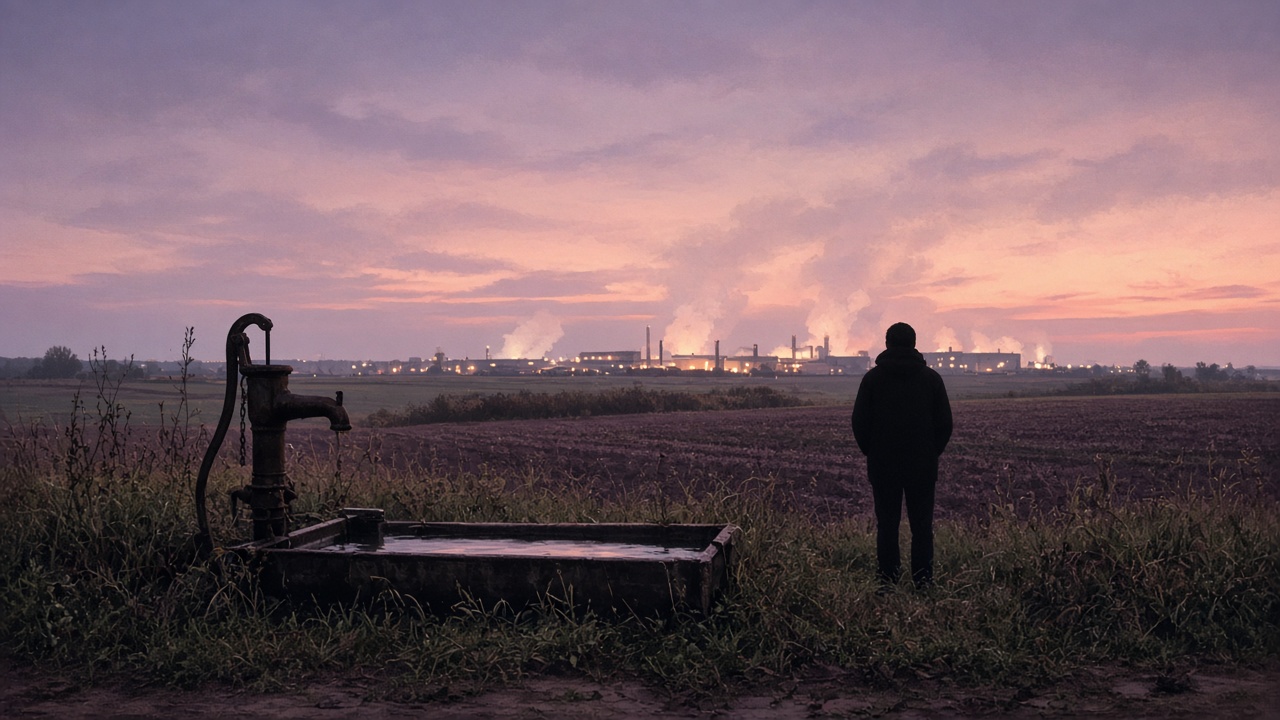
The cloud is not in the sky.
It is in somebody's backyard.
It has a zip code. A well. A power bill. A neighbor who cannot sleep.
I build with AI. I hold a patent on a neural network that generates recipes, and I founded a company that runs on models every day. So I am not writing this from outside the machine. I am writing from inside it, asking a question I think every builder owes the places that host our work.
Who gets to eat, breathe and drink while we compute?
Drink.
In Newton County, Georgia, a couple living about 1,000 feet from a Meta data center told The New York Times their taps ran dry and filled with sediment after construction began. Meta's own study said its operations were unlikely to affect groundwater. Local officials did not know the cause, and no one had tested the wells before construction.
That is the part I keep returning to. Not the verdict. The missing baseline.
We cannot hold anyone accountable for water we never measured.
Zoom out and the numbers get big. Researchers led by Pengfei Li and Shaolei Ren project that global AI demand could withdraw 4.2 to 6.6 billion cubic meters of water in 2027. A 2026 study of 9,347 data centers found 28% overlap with irrigated agriculture water demand.
Water for chips and water for crops, drawn from the same ground.
Here is the tricky part. Per prompt, the numbers look tiny. Google estimates a median Gemini text prompt uses about 0.26 milliliters of water, roughly five drops. I believe them. I also know that five drops times billions of prompts, sited on a stressed aquifer, stops being a rounding error and becomes a land use decision.
Efficiency per query is not the same as fairness per place.
Breathe.
In Southaven, Mississippi, just over the state line from Memphis, the NAACP sued xAI in April 2026 over gas turbines powering its Colossus 2 data center, alleging they run without permits. In announcing the suit, Earthjustice and the Southern Environmental Law Center said the turbines could emit more than 1,700 tons of nitrogen oxides a year. The case is still being fought.
Smog does not stay on the property line.
A UC Riverside and Caltech study estimated that air pollution tied to data center power could cause up to 1,300 premature deaths a year in the US by 2030. Backup generators in Northern Virginia alone were linked to $190 million to $260 million a year in regional health costs, drifting into neighboring states and Washington, DC.
The bodies that pay are rarely the ones that profit.
Sleep.
In 2022, in the Great Oak neighborhood near Manassas, Virginia, one resident told the Prince William Times: "If I'm outside, it's a constant humming. It sounds like I'm next to a highway." Another neighbor measured 67.4 decibels near her home. The county's nighttime residential limit was 55.
Noise is not a nuisance. It is a health input.
Eat.
This is where my two brains meet, the food scientist and the technologist.
The National Wildlife Federation reports that about two-thirds of planned US data centers are proposed in rural areas. Farmland gets rezoned. Land prices climb for the farmers who stay. In Virginia, fifth-generation farmer Cory Garrett is fighting a county effort to take his riverfront land for a pipeline that would carry up to 14 million gallons of water a day to support data center development.
Food is downstream of water, land and labor. So is AI. We just hide the second supply chain better.
Every recipe I have ever helped a model generate starts with a farm.
If AI eats the farm, what exactly are we optimizing?
Pay.
Then there is the bill. Researchers at Harvard's Electricity Law Initiative warn that special utility deals for data centers can shift costs onto everyday ratepayers. Bloomberg found wholesale electricity prices up as much as 267% over five years in places near significant data center activity.
Grandmothers on fixed incomes should not subsidize my inference costs.
Who pays is not an accident. It is a design decision, made in rate cases and permit hearings most of us never attend.
Building and accountability are not opposites.
I want to be clear. I love this technology. I have spent my career making food data legible, and AI is how a lot of that gets done.
Accountability is not anti-innovation. It is quality control.
The ethics of building with AI are not abstract to me. They show up in which model we call, which cloud region we pick and which vendor we renew. Small choices, made millions of times.
And better is already possible. Microsoft says its new data center designs evaporate zero water for cooling. Google and Mistral have published per-prompt energy and water estimates. The methods differ, and that is the point: once numbers are public, they can be argued with.
The sociologist Tressie McMillan Cottom has been tracking who is pushing back. In a June column for The New York Times, she described regular people in rural Utah and North Carolina organizing against data centers, speaking at public hearings and sitting through sessions on water rights, land use and thermodynamics. Later that month she wrote on Bluesky that she had asked some cousins and folks at a cookout about data centers, and "All of them had a clear anti AI argument."
That is not a fringe. That is the table.
Communities are making their own data legible too. Tucson's council unanimously ended Project Blue over water concerns. In Virginia, the Prince William Digital Gateway rezonings were voided in court, and in 2026 the appeals were dropped. California now requires water disclosure for data centers starting in 2027. Europe already requires annual reporting.
What I commit to.
- Use the smallest model that does the job well. Bigger is not smarter when the task is structured.
- Ask our own vendors the hard questions. Where our workloads run, how they are cooled and what each task costs in energy and water. At Journey, we wrote Data Centers With a Conscience: How an AI Company Should Be Held Accountable (Starting With Us), with the questions every food brand can ask, starting with us.
- Keep funding durable carbon removal. Journey contributes a share of revenue through Stripe Climate to carbon removal via Frontier. It is not a permission slip. It is a floor.
- Choose data that reveals rather than obscures. Including about ourselves.
What I ask of other founders.
- Know where your compute lives. Name the region, the cooling and the power.
- Ask for WUE, PUE and per-query numbers, and reward vendors who publish them. Tools like the AI Energy Score make comparison possible.
- Support disclosure laws instead of lobbying around them.
- Count neighbors, not just tons. Wells, lungs, sleep and rent are part of the footprint.
As a creative scientist, I believe the most interesting problems live where beauty and evidence meet.
This is one of them.
Every cloud has a water bill.
Let's read it out loud, together, and build like the neighbors are watching. Because they are. And they are also us.