


Nobu Documentary Review: Who Gets the Credit
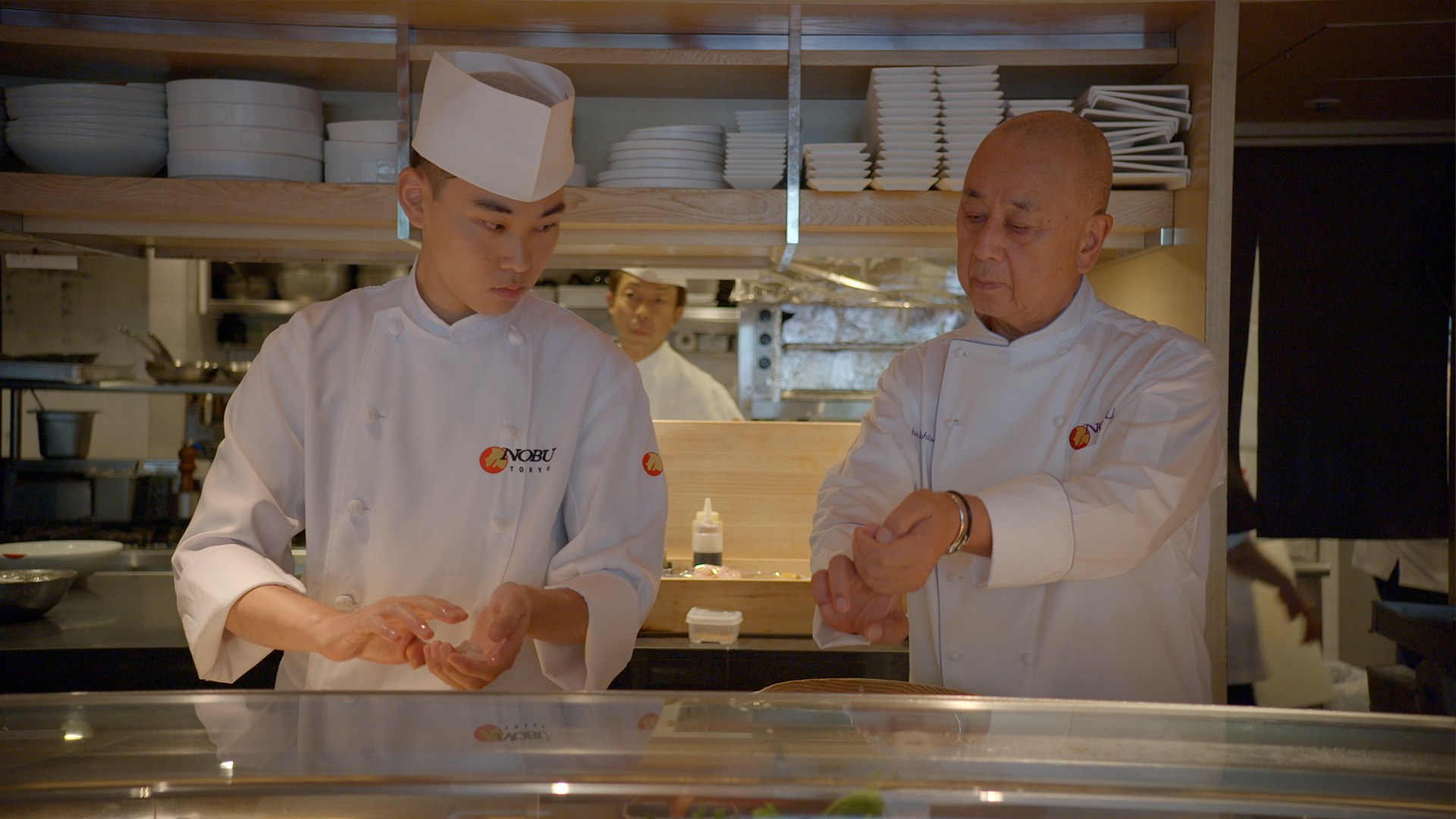
Every famous chef's name is a kind of shorthand. It stands in for hundreds of cooks, partners, suppliers and investors. Nobu, Matt Tyrnauer's documentary about Nobu Matsuhisa, is most interesting when it lets you see past the shorthand.
I ranked it among the best food movies of 2025, and I asked a question there that I still think is the right one: can intimacy survive scale? Here is the longer version.
The details: Nobu (2025). Directed and produced by Matt Tyrnauer, whose earlier films include Valentino: The Last Emperor. Based in part on Matsuhisa's 2014 book, Nobu: A Memoir. Featuring Nobu Matsuhisa, Robert De Niro, Meir Teper, Wolfgang Puck and Jean-Georges Vongerichten. In English and Japanese, 110 minutes. World premiere at the Telluride Film Festival in 2024, New York premiere at Tribeca in June 2025, released in theaters by Vertical in summer 2025. Available to rent or buy on Apple TV.
The immigrant chef
The biography is the backbone, and it is worth knowing before you watch. Matsuhisa was born in Saitama, Japan, in 1949. His father died when he was a child. He started as a dishwasher at a Tokyo sushi restaurant and trained there for seven years.
In 1973, at 24, he moved to Lima and opened a restaurant there with fellow chef Toshiro Konishi. It closed after about three years. He went to Argentina briefly, then to Anchorage, where his new restaurant burned down in an electrical fire weeks after opening. He arrived in Los Angeles in 1977 and opened Matsuhisa on La Cienega in 1987.
That arc is the part of the film I connect with most. Founders love to tell the story of the big success. The real lesson is in the closures, the fire and the years of rebuilding. As the Associated Press put it, the film covers the financial woes, the doubters and the fire, and I am glad it does.
Peru to Japan to LA
Nobu's food is often called fusion, and his signature style grew out of improvising with Peruvian ingredients in Lima. Chili, citrus and cilantro meeting Japanese technique.
But I want to add context the word "fusion" can hide. Peru has one of the oldest Japanese communities in Latin America, and Japanese Peruvian, or Nikkei, cooking has its own long history. Nobu was a talented chef who learned from that place, not a lone inventor. The best way to watch this film is with that in mind. Cuisines are built by communities over generations, and then sometimes a single name becomes the way the world remembers them.
The system behind the brand
The first Nobu opened in New York's Tribeca in 1994 as a partnership between Matsuhisa, Robert De Niro, restaurateur Drew Nieporent and producer Meir Teper. Today the brand spans more than fifty restaurants plus hotels, according to the AP.
That is a business story as much as a food story. In my 2025 list, I wrote that building the systems behind the fiftieth restaurant is the second challenge. This film shows a bit of how that works. Nobu describes corporate teams that travel to train each new location. Tyrnauer filmed him correcting his chefs, and told the AP that Nobu started as a graphic designer, which you can see in the plates.
As someone who builds data and AI tools for food companies, I find this the most underrated part of the story. Consistency at scale is an engineering problem. Recipes have to become standards. Taste has to become training. A chef's instinct has to become a system other people can run.
Who gets credit at the table
So who gets credit? The name on the door gets most of it, and the film is a portrait, so that is fair. But the documentary also shows a partnership structure, investors with famous faces and a global operation powered by teams who will never be household names.
I want food films to pay as much attention to those people as they do to the founder. La Cocina does it from inside a kitchen. Tony does it by remembering a famous chef before the fame. And Aisha's Story does it by centering a family whose food work holds an entire heritage together, with no brand at all.
Verdict
Watch it, especially if you are building something. Nobu is a polished portrait, and it leans toward celebration. But underneath the celebrity cameos is a real story about immigration, failure, partnership and the hard work of turning one person's taste into a system. The question it leaves me with is the right one for every founder: when your name gets bigger than your kitchen, who are you making room for?
Cover image: Courtesy of Tribeca Festival via TribecaFilm.com